What Are the 8 Genres of Fiction?
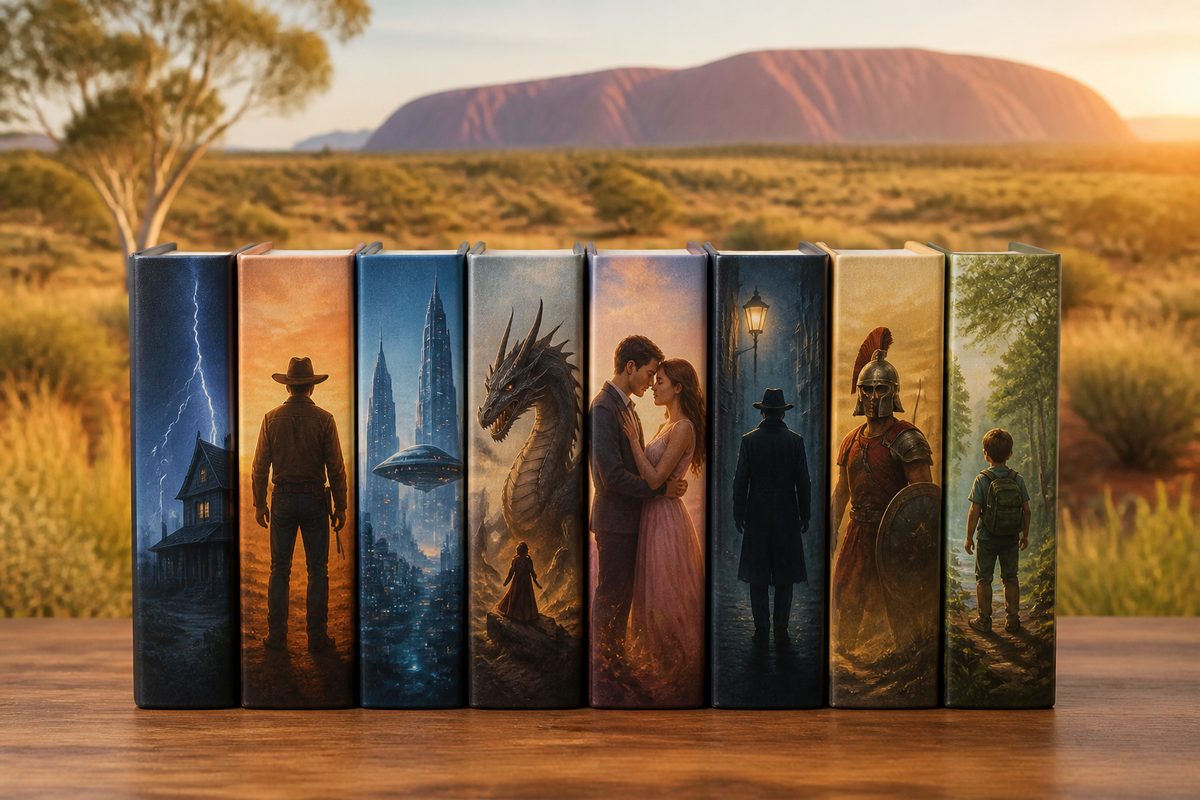
The eight genres of fiction most commonly listed are literary fiction, mystery, thriller, romance, science fiction, fantasy, horror and historical fiction. There's no official, universal list, though. Publishers, libraries, bookshops and teachers each draw the lines a little differently. So think of this eight-part split as a practical map, not a rulebook.
This guide explains what defines each category, where the boundaries blur, and how to use the list when you're choosing a book or planning your own writing.
Some versions of the list swap in adventure, western, young adult or magical realism. Others fold thriller into mystery. The version here covers the ground most readers actually shop by. It also reflects how Sunraysia Arts Guide sees the topic: as a reader-friendly starting point, not a claim about the one correct taxonomy.
Why Fiction Gets Sorted Into Genres at All
A genre is a promise. Pick up a book labelled romance and you expect a central relationship and a happy, satisfying ending. Pick up a mystery and you expect a puzzle that gets solved. Those expectations help readers find what they want. They also tell writers which conventions to honour, bend or break.
The umbrella term for books that follow these familiar patterns is genre fiction. People often set it against literary fiction, though the gap is shakier than it sounds. Plenty of celebrated novels use the machinery of a murder mystery or a space voyage. Plenty of popular genre books are beautifully written.
The real difference is emphasis. Genre fiction leads with plot and pattern. Literary fiction tends to lead with character, language and theme.
1. Literary Fiction
Literary fiction is the category for books judged mainly on style, inner life and ideas. Pacing is often slower. Endings can be unclear. The story may be driven more by a character's inner shifts than by outside events. Because the label is partly about how a book is received, it's the messiest genre on the list.
Writers here pay close attention to every literary device they can use: symbolism, unreliable narration, shifting point of view, motif and irony. Other genres use those tools too. But here they're often the main attraction. If you enjoy reading a sentence twice because it's beautiful, this is probably your shelf.
2. Mystery
Mystery fiction is built around a question the reader gets to solve alongside a detective, amateur sleuth or ordinary person. A puzzle is posed. Clues are planted. Suspects show up, and the answer comes in a way that feels earned. The fun is in your head: you want to be surprised, but you also want the solution to feel fair.
Mystery is closely tied to crime fiction, and people often use the two terms for the same thing. Here's a handy way to split them. Mystery centres on who did it and why. Crime fiction is the bigger family, which also includes stories told by criminals, police procedurals and legal dramas. Not every crime story is a whodunit, but nearly every whodunit is a crime story.
3. Thriller
A mystery asks you to work something out. A thriller wants your pulse to rise. The key ingredient is tension: a ticking clock, a threat that keeps growing, a hero in danger. The reader often knows more than the characters do, or feels a disaster coming. The pull comes from wanting to know if it can be stopped.
Thrillers borrow from everywhere. There are psychological, legal, spy and medical thrillers. Many sit in the same bookshop section as crime fiction, which is why some lists merge the two. Still, thriller earns its own entry because the reading feels different. Less puzzle. More chase.
4. Romance
The romance novel centres on a growing relationship between its leads and, in the classic form, promises a hopeful ending. That promise is the defining feature, more than any setting or time period. Romance is among the best-selling categories in publishing. It's also one of the most varied, with subgenres from historical and regency to contemporary, paranormal and romantic comedy.
The structure is well understood, so romance rewards fresh voices and unexpected pairings. Readers know roughly where the story will land. The interest is in how the characters get there and what stands in their way.
5. Science Fiction
Science fiction explores what happens when something changes, whether in science, society or technology. It asks "what if?" and then follows the idea honestly. Settings can be other planets, far futures, alternative presents, or ordinary lives reshaped by one invention.
Technology is a steady engine in the genre, from artificial intelligence and space travel to biotechnology and surveillance. At one end sits hard science fiction, which stays close to real science and makes sure its ideas are believable and consistent. At the other end are softer, more social or philosophical stories. There the science is just a backdrop for questions about people and society.
One of the genre's longest-running strands is utopian and dystopian fiction. These stories imagine societies that are either ideal or oppressive, and they use them to comment on the present. Whether the setting is a perfect city or a controlled state, they work as thought experiments about power, freedom and what a community will give up.
6. Fantasy
Fantasy takes place in worlds where magic or the supernatural is real within the story's rules. It might be an invented world with its own maps and histories. Or it might be a hidden magical layer beneath everyday life. Dragons and wizards are the cliché, but the genre also holds grim, political epics, gentle cosy tales and retellings of myths.
The big craft question in fantasy is consistency. Readers will accept almost any impossible thing as long as the story respects its own logic. Fantasy and science fiction often share a shelf and are sometimes called speculative fiction. But they explain things differently. Science fiction leans on reasoned guesses about what could come next. Fantasy leans on wonder and myth.
7. Horror
Horror fiction aims to unsettle, frighten or disturb. It may rely on supernatural threats, human cruelty, a mind coming apart, or a creeping sense that something is wrong. The best horror is less about shock than dread. It makes ordinary places feel unsafe and lets the reader's imagination do much of the work.
A major tradition in the field is Gothic fiction, which pairs mood, decay, isolated settings and dark secrets with strong emotion. Crumbling houses, haunted pasts and morally shady characters are its hallmarks. Gothic writing shaped much of what we now call horror. Its reach extends into romance, mystery and even literary fiction.
Mary Shelley's Frankenstein is often cited as a book that sits on the border between Gothic and science fiction. It shows how fluid these categories are.
8. Historical Fiction
Historical fiction is set in a recognisable past and tries to bring it to life through invented characters, real events or a mix of both. The craft challenge is balance. You need enough detail to make the period convincing, without turning the story into a lecture.
Writers in this genre research customs, language, clothing and social structures. Then they decide how closely to follow documented history. Some stories stick close to known facts. Others use the past as a stage for something entirely imagined. Either way, the reader gets to see another era from the inside.
When One Label Is Not Enough
Real books rarely fit neatly in one box. A hybrid genre is a work that deliberately mixes the conventions of two or more categories, such as a historical mystery, a science fiction romance, or a Gothic literary novel. Hybrids are common because writers are curious and readers are flexible. The mix often gives the most memorable results.
Hybrids also explain why lists disagree. A bookseller might file a murder set in a Victorian house under mystery, historical fiction or Gothic, depending on which feature they want to highlight. For readers, the label is a signpost, not a fence. If you like two genres, hunting for hybrids is a reliable way to find new favourites.
Length and Form Cut Across Every Genre
Genre describes content and mood, not length. Every category above can be told as a novel, a novella or a short story. Short fiction is a great way to sample a genre cheaply. You can read a tense thriller, a spooky Gothic tale or a quiet literary piece in one sitting.
It's also a common training ground for writers, who can test a genre's conventions on a small scale before committing to a full manuscript.
Many writers find that a short story in an unfamiliar genre teaches them more about structure than a long project in a comfortable one. A mystery forces you to plant clues. A romance forces you to build chemistry fast. A horror piece forces you to control tension line by line.
How to Use the List as a Reader
If you're trying to work out what to read next, the eight genres are a handy starting point. Here are a few practical ways to use them:
- Start with the feeling you want. Curious and puzzled points to mystery. Tense and breathless points to thriller. Warm and hopeful points to romance. Unsettled points to horror.
- Look for the promise, not just the label. If you disliked a particular fantasy novel, ask whether it was the magic, the length or the pacing that bothered you before ruling out the genre.
- Try a neighbouring genre. Mystery readers often enjoy crime fiction, science fiction fans often enjoy fantasy, and Gothic lovers often enjoy horror and historical fiction.
- Sample through short fiction. Anthologies and magazines are low-risk ways to test unfamiliar ground.
How to Use the List as a Writer
Knowing the genres helps you decide which promises you're making. Readers come to each one with expectations. Meeting them, or knowingly flipping them, is part of the craft. Before you start drafting, try answering a few questions:
- Which genre best describes the core experience I want to give readers?
- What are the two or three conventions readers will expect, and how will I handle them?
- Am I blending genres on purpose, and have I made clear which one leads?
- Which books on a shelf would sit next to mine, and what makes mine different?
Those answers also shape how you describe the book to others. A clear sense of genre makes your pitch, your cover and your opening pages work together. If you're planning a full manuscript, our guide on How Do You Write a Successful Book? covers planning, drafting and publishing paths in more depth.
Genres Beyond the Eight
The eight-genre list leaves out plenty. Adventure, western, young adult, children's fiction, magical realism, satire and humour all have devoted readers. Many are better seen as audiences, tones or settings than as separate genres.
Some overlap with the eight. A western is often a kind of historical adventure. Young adult can be any genre aimed at a certain age group. Satire is a mode that can show up in almost anything.
That flexibility is a feature, not a flaw. Genre is a conversation between writers and readers, and it keeps changing. New hybrids appear, old labels fall out of fashion, and categories get redrawn whenever someone writes a book that doesn't quite fit. The point of learning the list isn't to memorise a final answer. It's to gain words for talking about what you love.
Genre in the Wider Arts
The idea of genre isn't limited to books. Painting, theatre, film and music all use categories to tell an audience what to expect. If you enjoy thinking about how those labels work across creative fields, What Are the Different Genres of Art? explores the visual side of the same question. You can find more independent coverage of creative practice in the region at Sunraysia Arts Guide.
Bottom Line
The eight genres of fiction usually cited are literary fiction, mystery, thriller, romance, science fiction, fantasy, horror and historical fiction. Treat them as a flexible starting point. Each carries a set of reader expectations, many books blend several, and the best way to understand them is to read widely, including a few short stories outside your comfort zone.
Once you can name what a book is promising, you can choose better as a reader and write more deliberately as an author.