Is Ai Actually Replacing Artists?
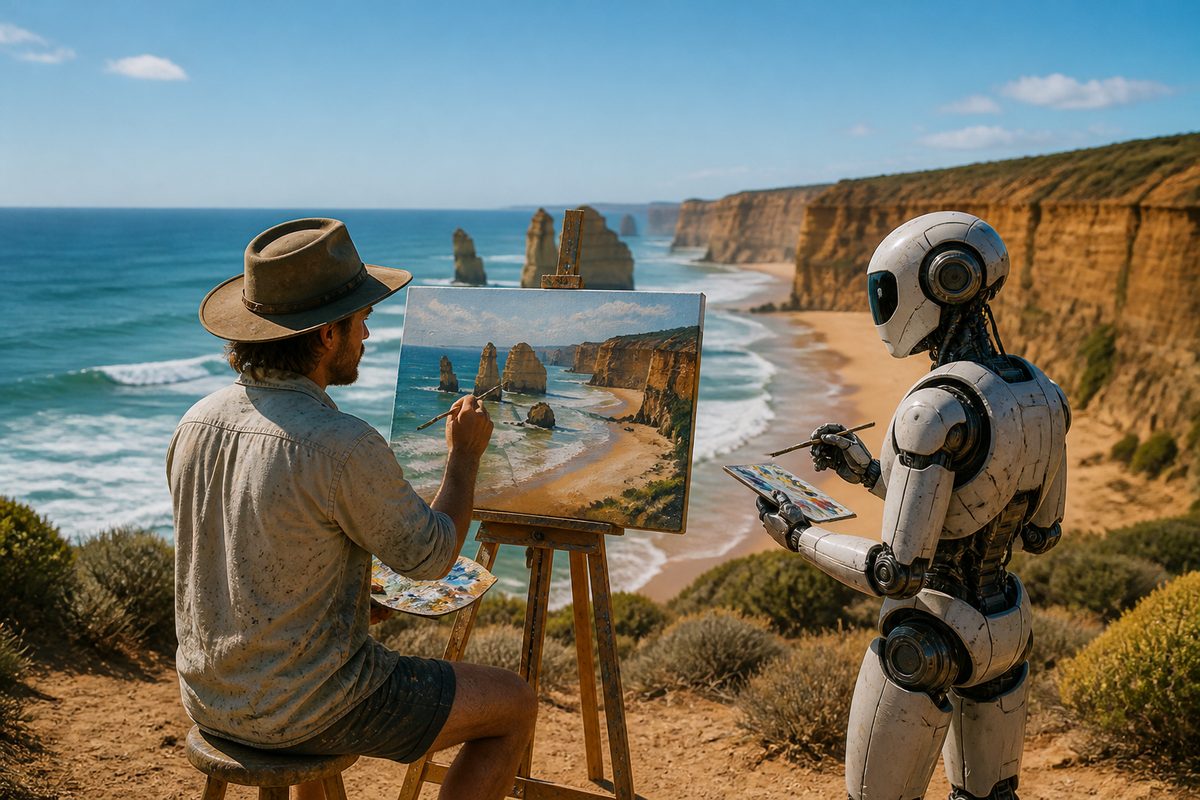
No, AI is not replacing artists as a whole. But it is replacing some of the paid tasks that artists, illustrators and designers have relied on. The difference matters. Art as a human practice, with its ideas, relationships and lived context, carries on. Some kinds of commissioned image work are feeling real pressure, especially fast, low-budget and generic jobs.
This guide separates the worry from the evidence. Working and aspiring creatives can see where the risk sits and where it doesn't.
We're an independent editorial guide. We have no product to sell you and no side to take. What follows is a plain read of how the technology works, what the law says right now, and what it means for people who make art for a living or for love. That includes those in regional communities such as Sunraysia. For more local arts coverage, see Sunraysia Arts Guide.
What Is Actually Being Called "AI Art"
Most of the current debate is about Generative AI: software that makes new images, text, audio or video from a request. A generative model is trained on huge collections of existing material. It learns patterns, such as what a face, a brushstroke or a certain lighting style tends to look like.
When someone types a request, the model builds a new output that fits those patterns.
The term generative artificial intelligence covers a wide range of tools, and they aren't all alike. Some are open. Some are tightly controlled by a company. Some are built into familiar creative software. Lumping them together makes the question sound simpler than it is.
A tool that makes a finished image from one sentence is a very different thing from a tool that helps a painter remove a blemish from a photo of their own work.
The best-known examples include Stable Diffusion, an image model released by Stability AI, and Adobe Firefly, a set of generative features from Adobe Inc. They differ in how they were built, how they're licensed and how people use them. That matters once we get to the legal and ethical questions.
Where the Pressure Is Real
It would be dishonest to say nothing is changing. Working artists and illustrators have raised concerns, and several are reasonable. The most exposed areas share a few traits. They're fast, they're price-sensitive, and the buyer mainly needs "an image" rather than one person's vision.
- Stock-style imagery. Generic illustrations for blog posts, slide decks and social posts can now be made in seconds. That weakens the case for commissioning or licensing them.
- Concept and mood exploration. Early visual brainstorming used to mean paid sketches. Some clients now generate rough ideas themselves before they ever contact an illustrator.
- Low-budget commissions. Buyers who already paid very little are the quickest to try a free or cheap tool instead.
- Entry-level work. Small jobs often act as the first rung for new creatives. If those vanish, the way into the profession gets harder, even if the profession survives.
This is a real shift in how some creative income flows. It's better described as displacement of particular tasks than as the replacement of artists in general. But if your income depended on those tasks, that distinction offers little comfort.
Where Artists Are Much Less Exposed
Several parts of the creative world rest on things a generative model can't supply.
Work That Depends on a Person
Portraits of a specific family. A mural for a particular wall. A sculpture made for a particular park. People value these because of who made them, where they sit, and the story around them.
A buyer is often purchasing a relationship and a point of view as much as an object.
Fine Art and the Gallery World
Fine art is a field where the maker's identity, intention and body of work are central to value. Collectors, curators and audiences tend to ask who made a piece, why, and in what context. A convincing image on its own doesn't answer those questions.
Galleries, residencies, prizes and public commissions are built around human artists. Nothing about the technology automatically changes that. How galleries operate and pay artists is a separate topic, and it's worth reading about alongside this one if you're weighing a career move.
Physical and Live Practice
Ceramics, printmaking, textiles, painting on canvas, performance, community workshops and public art all rely on hands, materials and presence. A generative model makes digital outputs. It doesn't throw a pot, run a workshop in a town hall or stand in front of a crowd.
Taste, Direction and Accountability
A client with a brief still needs someone to interpret it, make decisions and take responsibility for the result. They need someone to revise it when the first attempt misses. Those are professional judgement skills, and they sit at the centre of most successful creative careers.
The Skill Called Prompt Engineering
A new vocabulary has grown up around these tools, and prompt engineering is one of the more visible terms. It means the craft of wording requests so a model produces something closer to what the person intended. Some people see it as a new creative skill. Others say it's closer to commissioning than to making.
Both views have something to them. Getting a steady, usable result from a generative model often takes trial and error, an eye for composition and knowledge of what the tool can and can't do.
But the person writing the request isn't using the same hands-on and conceptual skills as someone who draws, paints or sculpts. For artists, the practical point is this: knowing these tools can add to a practice rather than replace it, if they choose to use them at all. Plenty of respected artists decline to. That's a legitimate stance.
What the Law Currently Says About Ownership
Who owns AI-made images isn't settled everywhere, and the rules differ between countries. The best-documented position comes from the United States, which many global platforms and companies follow closely.
Under Copyright law of the United States, protection has traditionally depended on human authorship. The United States Copyright Office has published guidance saying that material made entirely by a machine, without enough human creative input, can't be registered.
Where a person makes meaningful creative choices, such as selecting, arranging or heavily changing generated material, those human contributions may be protected. The Office has also said that simply typing a request is generally not enough on its own. This kind of detail can change, so anyone relying on it commercially should check the current guidance rather than trust a summary.
Australia has its own copyright framework, and it also puts weight on human authorship. If you plan to sell or license work made with generative tools, get specific advice. Don't assume you automatically own the result.
This matters for the "replacement" question in a practical way. If a business can't reliably claim exclusive rights over a purely machine-made image, that weakens one of the main commercial reasons to prefer it over work from a human artist whose rights are clear.
The Training Data Dispute
A second legal and ethical fight is about how these models were built. Many were trained on enormous collections of images gathered from the internet. Many artists say their work was included without permission, credit or payment.
Stability AI, the company behind Stable Diffusion, has faced legal action brought by artists and by an image library, and the cases have been widely reported. Litigation like this develops over time. It's best to follow current reporting rather than rely on a snapshot of where any case stood.
Companies have responded in different ways. Adobe Inc. has described Adobe Firefly as trained on licensed material, such as its own stock library, and on content whose copyright has expired. It has positioned this as a more commercially cautious option. Whether any approach fully settles artists' concerns is still debated, so read each provider's own terms rather than assume.
The broader point is that the industry is split over what counts as fair treatment of creators. That argument is far from over.
A More Accurate Frame: Change, Not Disappearance
History offers a useful, if imperfect, comparison. When photography became widespread, portrait painters faced real competition, and some lost work. Painting didn't vanish. It changed. Many artists moved toward things a camera couldn't do, or picked up the camera themselves. Digital tools did something similar for illustration, music and design.
The comparison has limits. Earlier technologies didn't learn from the work of the very people they competed with. That's a big part of why this moment feels more fraught to many creatives.
Still, the pattern suggests what's most likely: a reshaping of where artists earn money and what clients will pay for. Not an end to the profession.
Practical Steps for Working Artists
None of the following guarantees anything. But these are sensible ways to respond to the current landscape.
- Lean into what is clearly yours. A recognisable style, a body of work, a story and a local reputation are hard to copy as a package.
- Be transparent about your process. Many buyers value knowing a piece was made by hand. Sketches, studio shots and works in progress build trust.
- Read the terms of any platform you upload to. Some services let your images be used for training unless you opt out, so check the settings before you post.
- Keep records. Dated files, drafts and contracts help prove authorship if a dispute ever comes up.
- Write clear contracts. If you're commissioned, spell out whether AI tools may be used, who owns the final work and how it can be reused.
- Diversify your income. Teaching, workshops, commissions, exhibitions, prints and public projects spread the risk when one stream is under pressure.
- Try the tools on your own terms. If you're curious, experiment. Decide for yourself where, if anywhere, they belong in your practice.
What It Means for Regional Arts Communities
Regional scenes lean heavily on personal connection: markets, open studios, community exhibitions, school programs and local commissions. In those settings, a person's presence is part of the offer. A visitor buying a landscape painted a few streets away isn't simply buying an image. A generative model can't copy that context.
At the same time, regional artists often wear several hats, such as designer, teacher and maker. They may feel the pull on lower-cost design and illustration work.
Staying informed, sharing what you learn with peers and backing local artists directly are practical ways a community can keep creative work valued.
How to Support Human Artists as a Buyer or Audience Member
If you commission, buy or share art, your choices count. Ask who made a piece. Pay fairly and on time. Credit artists when you reuse their work.
If you use generative tools for something where a human artist would have been hired, ask whether that fits your project and your values. Choosing to hire, buy and attend is the most direct way to keep creative work sustainable.
Bottom Line
AI is changing parts of the creative economy, and some artists are already feeling it, especially in generic and low-budget image work. It isn't replacing artists as a group, because so much of what makes art valuable comes from human intention, skill, presence and relationships.
The legal picture is still developing, including how copyright applies and how training data should be treated. So it pays to stay informed and protect your own work. The most realistic outlook is a changing landscape, and artists who can show what only they offer stay well placed.