Writing About the Mallee: Landscape, Drought and Memory in Australian Literature
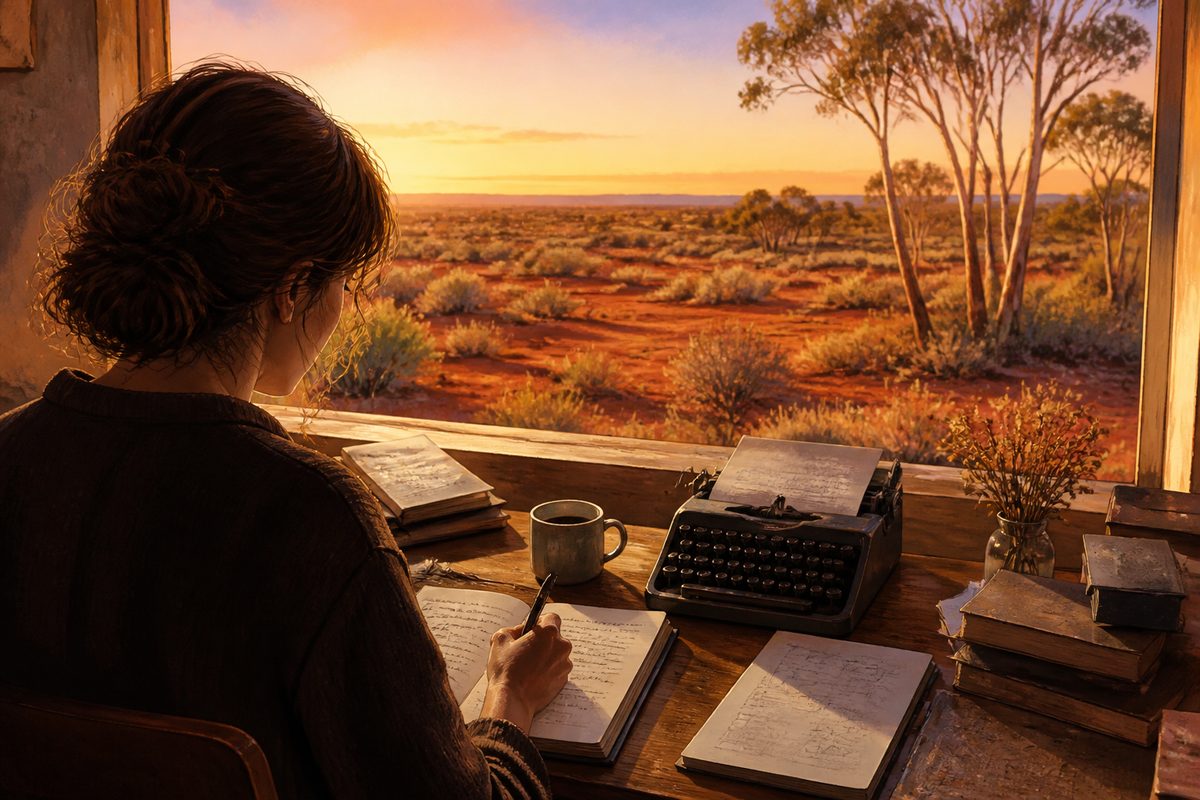
Writing about the Mallee in Australian literature means writing about a dry, low, easily overlooked country in which drought, land clearing and loss of place shape how stories are told. The Mallee isn't a single tidy literary canon. It's a landscape that turns up in fiction, poetry, memoir and nature writing, often indirectly.
The best way to read it is to follow a handful of recurring themes: the scrub itself, the cycle of dry years, the dust and the memory that settles with it. This guide, from Sunraysia Arts Guide, is an independent reading companion. It's not a definitive bibliography.
What the Mallee Is, and Why It Resists Easy Description
The name refers both to a type of eucalypt and to the broad region where those trees dominate. The tree grows as multi-stemmed shrubs or small trees from a woody underground base. The country sits across north-western Victoria, the east of South Australia and parts of New South Wales, and much of it lies within or beside the Murray, Darling basin.
Its semi-arid climate means rainfall is modest and unreliable. Summers are hot. The horizon is long and flat.
That plainness is exactly what makes the region hard to write about. Australian literature has often been drawn to dramatic landscapes: ranges, gorges, tropical coasts, red desert. The Mallee offers sand, scrub, wheat paddocks and sky.
A writer who wants to do it justice has to slow down and look for small things. The grey-green of the leaves. The way light moves across a salt pan. The sound of wind through dry stubble. Much of the best writing about places like this treats attention itself as the subject.
The Scrub as Obstacle, Resource and Character
For many early settlers, mallee scrub was something to be removed. It was thick, hard to burn cleanly and slow to clear. Farming it took enormous labour.
Writing from that period tends to cast the land as an enemy, a problem to be solved with axe, roller and fire. Later writing often flips the view. It sees the scrub as a living community of plants, birds and animals that was torn apart in a remarkably short time.
That shift is one of the most interesting things to trace across a reading list. Early accounts talk about progress and improvement. Later poetry and essays talk about absence: the cleared paddock as a kind of silence, the remnant patch of scrub as a surviving fragment of a lost world.
Neither view is the whole story. The most thoughtful writers hold both in the same sentence.
Drought as Structure, Not Just Setting
In much Australian writing, drought is more than weather. It gives a story its shape. A dry run of seasons squeezes a family's money, tests its relationships and forces choices about leaving or staying.
It also gives the narrative a clock. In a farming district, a failed season can reorganise a whole community.
Readers who want a modern reference point can look to the 2000s Australian drought, often called the Millennium Drought. It stretched across much of the south-east and left a deep mark on rural communities. It also changed the public conversation about water, rivers and the future.
Writers responding to that period tended to move away from the older romance of resilience. They moved towards something less certain: tiredness, grief, a sober count of what land can bear. Read an older drought story beside a post-2000 one and the difference in tone is striking.
Why Drought Fiction Rarely Feels Neutral
Farming country is tied so closely to livelihood that drought writing is rarely a detached look at nature. It carries questions of debt, inheritance, gender roles on the farm and the pressure on those who stay.
The weather is the backdrop. The real material is human endurance and the stories people tell themselves to justify it.
Dust, Wind and the Making of Memory
A dust storm is one of the most vivid images of dry farming country. A wall of red or brown cloud rolls across a paddock. In memoir and local history it becomes a shared event: people remember where they were, what they were doing and how the light changed.
Famous dust events in Australian history, including the one that reached Melbourne in the early 1980s, have stuck in the popular imagination for just this reason.
Dust is also a symbol of soil erosion, the quiet process by which bare, over-worked ground is carried away. The image works on two levels. Literally, it's a record of how land was managed.
Symbolically, it suggests that what's lost from a place doesn't simply vanish. It travels, settles elsewhere and is eventually noticed. Writers use dust to talk about things nobody can see directly: past decisions, absent families, unacknowledged histories.
Collective Memory and the Stories a District Tells
Collective memory is the shared version of the past that a community holds and repeats: the big drought, the good year, the family who walked off the land, the day the dust came. In small farming towns, these stories get told at the pub, in the local paper and in historical society newsletters. Over time they harden into a kind of oral literature.
Literary writers draw on this material, but they also test it. A community story may stress grit and neighbourliness. It may leave out who was shut out, who profited, or who was there before.
Reading Mallee-related writing well means noticing what a local memory includes and what it quietly leaves out.
Settler Colonialism and the Question of Whose Country
Any serious talk about landscape writing in Australia has to deal with settler colonialism. The clearing, fencing and cropping of dry country happened on land that Aboriginal peoples had cared for over a very long time. The language of “taking up” land often hid that fact. Earlier literature often describes the country as empty or waiting, when it was neither.
More recent writing challenges that framing. That includes work by First Nations authors and by non-Indigenous writers who look critically at their own heritage. It asks what it means to belong to a place, and how long-standing connection differs from recent occupation.
It also asks how a farming family’s attachment to its paddocks sits beside older claims. When you read about the Mallee, ask whose names for the land appear on the page. And whose are missing.
Reading Around the Region: Writers Worth Knowing
Let's be honest here. Few well-known Australian books are set squarely in the Mallee. So readers often build an understanding by reading nearby and related writing, then applying its lessons to the region. The following authors are useful companions, but none should be mistaken for a specifically Mallee author unless you confirm it in the book itself.
- Murray Bail is known for fiction that treats the rural Australian landscape with dry wit and close attention. Eucalyptus is set on a property in rural New South Wales and shows how trees and country can carry a whole story.
- Colin Thiele wrote widely about South Australian places and the people who work them, including farm and coastal settings. His books show how landscape can anchor a story for younger and general readers alike.
- Mary Grant Bruce belongs to an earlier era. Her Billabong stories gave many readers a picture of station life in rural Victoria. Read them critically, as examples of how settler childhood and the bush were romanticised.
- Nicholas Hasluck, a Western Australian novelist and poet, is worth reading for the way his work links place, law, history and memory, even though his settings lie outside the Mallee proper.
- Mark Tredinnick is a poet and essayist whose nature writing models the patient, detailed attention that dry and unshowy landscapes reward.
The point of reading these writers together is comparison. Notice how each handles weather, work, language and the weight of the past. Then bring those questions to anything you read that's set closer to the Murray.
Climate Fiction and the Future of Dry Country
Climate fiction is a growing field that imagines the effects of a warming world, and dry inland Australia is a natural setting. Writers in this mode can ask what happens when a semi-arid region becomes more arid. Or when rivers carry less water. Or when farming families face choices their grandparents never had to make.
This doesn't mean every drought novel is climate fiction. The label fits best when the story deals directly with environmental change and human responsibility, rather than using dry weather as scenery.
Still, the older drought stories and the newer climate stories are in conversation. The earlier works record what the land was like and what people believed about it. The newer ones ask what comes next.
How to Read Mallee Writing Well
A few habits make the experience richer:
- Look at the land first. Pay attention to specific plants, soils, birds and weather rather than skimming to the plot.
- Track the water. Rivers, bores, tanks and rain are rarely incidental in dry-country writing.
- Ask who is absent. Notice whose voices, languages and claims to the land are not on the page.
- Compare eras. Read a pre-war account beside a contemporary one and note how attitudes to clearing, farming and nature change.
- Check local sources. Regional histories, library collections and local writing groups often hold material that national lists overlook.
Where Local Readers and Writers Can Go Next
If you live in or near the region, your own surroundings are the best primer. Walk a remnant patch of scrub. Visit a local library’s regional history shelf. Talk with people whose families have farmed here for generations.
Writing groups and literary events in regional centres are also a good way to meet people working on the same themes. Check each organiser directly for current details before planning a visit.
For wider context on how books and ideas are shared in public, it can help to read about what a literature festival is and how the different kinds work. You could also explore how landscape sits within the broader genres of art. Seeing the Mallee as one subject among many forms of creative practice makes it easier to see why writers keep returning to it.
Why This Landscape Keeps Drawing Writers
The Mallee asks for patience. It doesn't announce itself, and it rewards people who stay long enough to notice. That's why it works so well for literature about memory: the land holds evidence of what was done to it, of what was lost and of what lasts.
Drought, dust and clearing aren't just historical facts. Writers use them as images to think about time, responsibility and belonging.
Whether you're a reader looking for a place to start or a writer trying to put this country on the page, the useful approach is the same. Look closely. Remember carefully. And be honest about whose story you're telling and whose you may have left out.
Bottom Line
Writing about the Mallee is writing about attention, absence and endurance. The region’s literature is spread across fiction, poetry, memoir and nature writing. It's best understood by following themes rather than hunting for a single canon: the scrub, the dry years, the dust, the shared stories and the unresolved questions of who belongs.
Start with the authors above for comparison, read local sources for specifics, and let the land itself teach you how to read.