What Is Site-Specific Art and Why Regional Towns Suit It
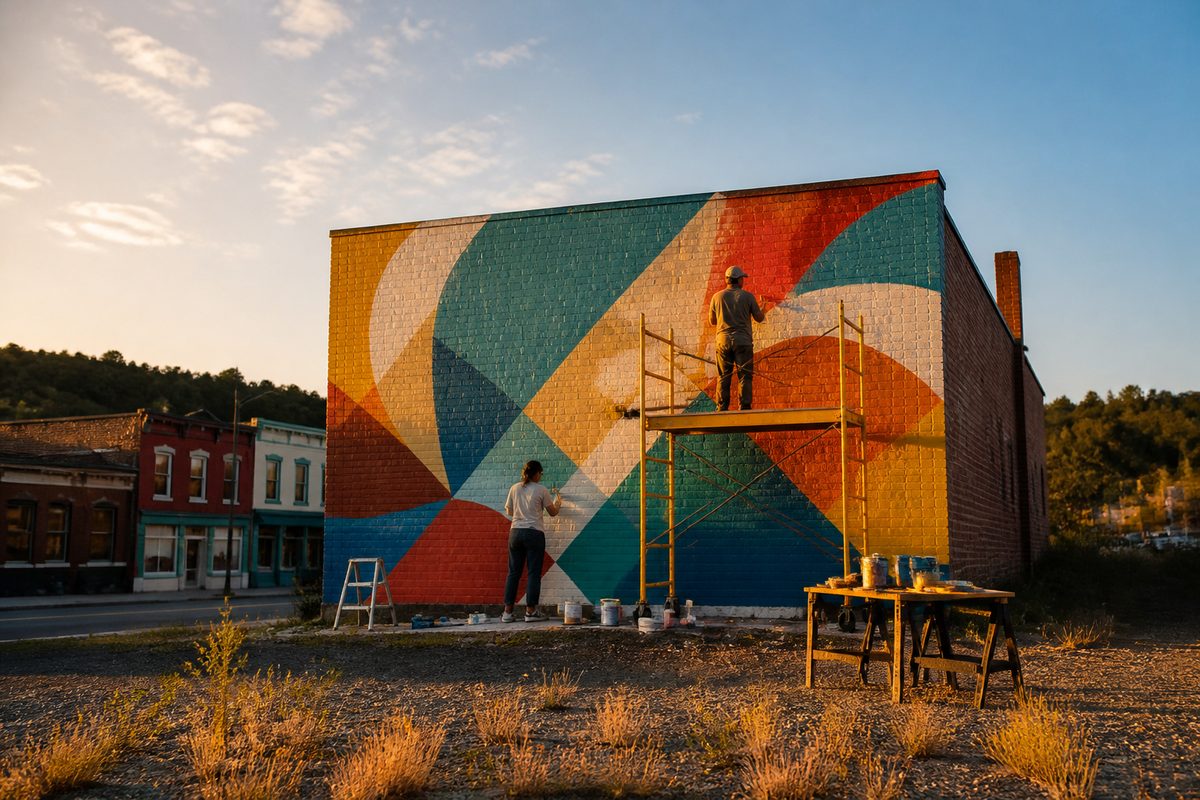
Site-specific art is work made for one particular place, so that its meaning, materials or form depend on that location and would change or disappear if it were moved. A painting can hang in any gallery and still be the same painting. A site-specific work can't be lifted out so easily, because the place is part of the work.
This guide explains the idea, where it came from, and why smaller towns and landscapes often host it better than big cities. It's an independent editorial piece from Sunraysia Arts Guide.
The definition is looser in practice than it sounds. Some artists treat the site as a physical setting, like a riverbank, a wall or a paddock. Others treat it as a social setting: a community, a local story or an institution. Most strong work pays attention to both.
The Core Idea: The Place Is Part of the Work
Most art is made in a studio and then sent out into the world. Site-specific art flips that order. The artist visits first, looks at the light, the scale, the history and the people, and then makes something in response.
The finished piece is a kind of conversation with where it sits.
That has a few practical results:
- It can't be easily relocated. Moving it often means rebuilding it, or accepting that it has become a different work.
- It may be temporary. Weather, tides, growth and decay can be part of the point.
- It asks you to travel. You usually have to go to the place to see it properly, and photographs only partly stand in for the experience.
- It changes how you see the setting. After meeting the work, an ordinary street corner or creek bend can look different.
Where the Idea Came From
Artists have always made work for particular spots, from carved church doorways to murals designed for a single wall. The modern idea took shape in the 1960s and 1970s. Many artists were fed up with the gallery as a neutral white box.
They wanted work that couldn't be bought, boxed and hung without losing something. Several overlapping practices grew from that urge. They're worth separating, because people often lump them together.
Land Art
Land art, sometimes called earthworks, uses the landscape itself as material and canvas. Robert Smithson is the best-known name. His Spiral Jetty, a coil of rock and earth built into the Great Salt Lake in Utah in 1970, is the standard example.
Its look changes with the water level. At times it has been under water, then shown again. The work can't be separated from that lake.
Environmental Art
Environmental art is a broader and often gentler category. It includes work that responds to ecosystems, and some artists also deal with ecological damage or repair. Andy Goldsworthy is closely linked to this approach.
He arranges leaves, stones, ice, twigs and clay in outdoor places. Often he photographs the result before the wind, rain or tide takes it away. The impermanence is deliberate. The photographs are a record, not the work itself.
Installation Art
Installation art builds an environment you walk into, rather than an object you look at. It can be site-specific when it's designed around a building, room or outdoor space, using the architecture and its history as raw material.
A disused hall, a shearing shed or a former shop can become the work's frame as well as its container.
Public Art
Public art is simply art placed where people meet it in daily life, such as parks, plazas, streets and transport hubs. Not all public art is site-specific. A statue made in a foundry and bolted onto a plinth is public, but it can be moved.
Public art becomes site-specific when the commission starts from the particular place and its community.
The Famous Argument About Moving a Work
The clearest lesson in what site-specific really means comes from Richard Serra. His steel sculpture Tilted Arc was installed in a plaza in New York in 1981. It cut across the space, and many people who used the plaza disliked how it blocked their route.
After a public hearing it was removed in 1989. Serra argued that the work was designed for that plaza, so moving it would destroy it. That's the sharpest statement of the principle: if the site is part of the work, relocation isn't preservation. It's demolition.
The episode also shows the risk of the form. A work that responds strongly to a place has to deal with the people who live and walk there, not only with the artist's intentions or the commissioning body.
Art That Questions the Setting
Some site-specific artists care less about landscape than about the institution or system around a place. This strand is often called institutional critique. Artists working this way might respond to a gallery's architecture, its funding, or its rules about who can enter or what counts as art.
The site is the museum, council or bureaucratic structure. The work makes that hidden framework visible.
In a regional setting the same instinct can be turned toward the town itself: who the main street was built for, whose stories the monuments tell, and whose are missing. Work like this isn't always comfortable. But it's one reason the form matters.
Temporary Spectacle and Community Process
Scale can be huge. Christo and Jeanne-Claude wrapped buildings and landscapes in fabric. That included Running Fence, a long white fabric fence that ran across hills in northern California in 1976, and the wrapped Reichstag in Berlin in 1995.
These projects lasted only days or weeks. Part of their power came from long talks with landowners, officials and neighbours. The artists treated those talks as part of the work, not a roadblock.
That detail matters for regional towns. Site-specific art is rarely just an object. It's often a process of talking, asking permission and working with locals.
Why Regional Towns Suit It
None of this is exclusive to small places, and cities host brilliant site-specific projects. But there are several reasons regional towns and landscapes match the form so well.
The Landscape Is Part of the Everyday
In a regional town, the surrounding country isn't a distant backdrop. River flats, orchards, irrigation channels, red soil, salt pans and wide skies are part of daily life. Artists responding to them work with material that locals already know well.
That gives the work an instant point of reference.
There Is Space
Cities are crowded with approvals, competing uses and tight sites. Regional areas often have open land, underused buildings and quiet corners. These could host work at a scale that would be hard to secure elsewhere.
Space doesn't guarantee good art. But it gives artists room to aim big.
Stories Are Close to the Surface
Smaller communities tend to hold their histories in living memory and in visible places: a pioneering irrigation scheme, a closed packing shed, a river crossing, a migrant community's contribution. This is rich ground for cultural heritage, the inherited places, objects and traditions a community wants to understand and pass on.
A site-specific piece can make heritage felt, rather than just labelled on a plaque.
Country Comes First
In Australia, any talk about place has to acknowledge that these landscapes have long been cared for and understood by Indigenous peoples, whose knowledge, language and law are bound to Country. Thoughtful site-specific work in regional areas begins by asking who already holds knowledge about the site and how to respect it.
Done properly, this means consultation and collaboration, not decoration. It also means accepting that some places carry meanings an outside artist shouldn't casually claim.
Visitors Come to the Work
Because site-specific art can't easily be moved, it gives people a reason to travel. That's where cultural tourism comes in: visitors choosing destinations partly for the art, history and creative life they can find there. A single striking installation can encourage someone to stay for lunch, explore nearby streets or return in another season.
We'd be cautious about promising any particular economic effect, since results vary. But the logic of art that draws people to a place is easy to see.
Trails Turn Single Works Into Journeys
A sculpture trail links several outdoor works along a route, often through a town, along a river or across a stretch of country. Trails suit regional areas because distances are walkable or drivable. And the walk itself becomes part of the experience.
Each piece can respond to its own spot while the whole sequence tells a larger story about the district.
Smaller Scale Means Closer Relationships
In a town where people know the shop owner, the council officer and the landholder, the practical work of approvals and local support can be more personal. That can make a community-led project easier to start.
It can also make local people feel like partners rather than an audience.
The Challenges Are Real Too
It would be unfair to present regional settings as a perfect fit. Several problems are common:
- Funding and maintenance. Outdoor works face sun, dust, wind and flood. Someone has to look after them, and long-term care is easy to overlook.
- Accessibility. A work in a remote spot may be impossible for many people to reach, especially those with limited mobility or no car.
- Local acceptance. As Tilted Arc showed, a work that feels forced on people can spark resistance. Early conversation matters.
- Safety and land management. Fire, flood, stock, public liability and environmental protection all shape what can be built where.
- Documentation. If a work is temporary, the record of it needs thought, so the effort isn't lost.
How to Experience Site-Specific Art Well
A few habits make a visit more rewarding:
- Arrive without expectations about form. It might be a sculpture, a sound, a projection or a painted wall.
- Look at the surroundings first. What is behind, beside and above the work? The context is part of what you're being shown.
- Read any available background. Notes on the site's history and the artist's research often unlock details you'd miss.
- Return at a different time. Morning light, evening shadow, rain and season can transform the same piece.
- Respect the place. Stay on paths, leave gates as you found them, and don't touch fragile work unless invited to.
- Ask who the work was made with. Was the community or Traditional Owner group involved? That question often shows how thoughtful the project is.
Telling It Apart From Similar Things
The terms overlap, so it helps to keep a few differences in mind. A sculpture placed in a park is public art but not necessarily site-specific. A mural painted to a designer's template that could appear in any town is decorative, not responsive.
An installation made for a gallery that could travel to another gallery isn't site-specific in the strict sense. A piece that makes sense only because of this riverbank, this building or this history is.
These lines aren't rigid, and artists and critics argue about them. What matters is the test: if you moved it, would it lose something essential?
Why the Idea Keeps Growing
Interest in art tied to place hasn't faded. People want experiences that can't be scrolled past or copied onto a screen. Work that demands a visit has a real pull.
For regional communities, it offers a way to tell their own stories on their own terms, rather than waiting for culture to arrive from elsewhere.
For anyone exploring a region's creative life, the practical advice is simple: look for the work that seems to belong where it stands, find out why it was put there, and give it time. The best site-specific art teaches you something about the place you thought you already knew.