How Many Pieces for an Art Portfolio?
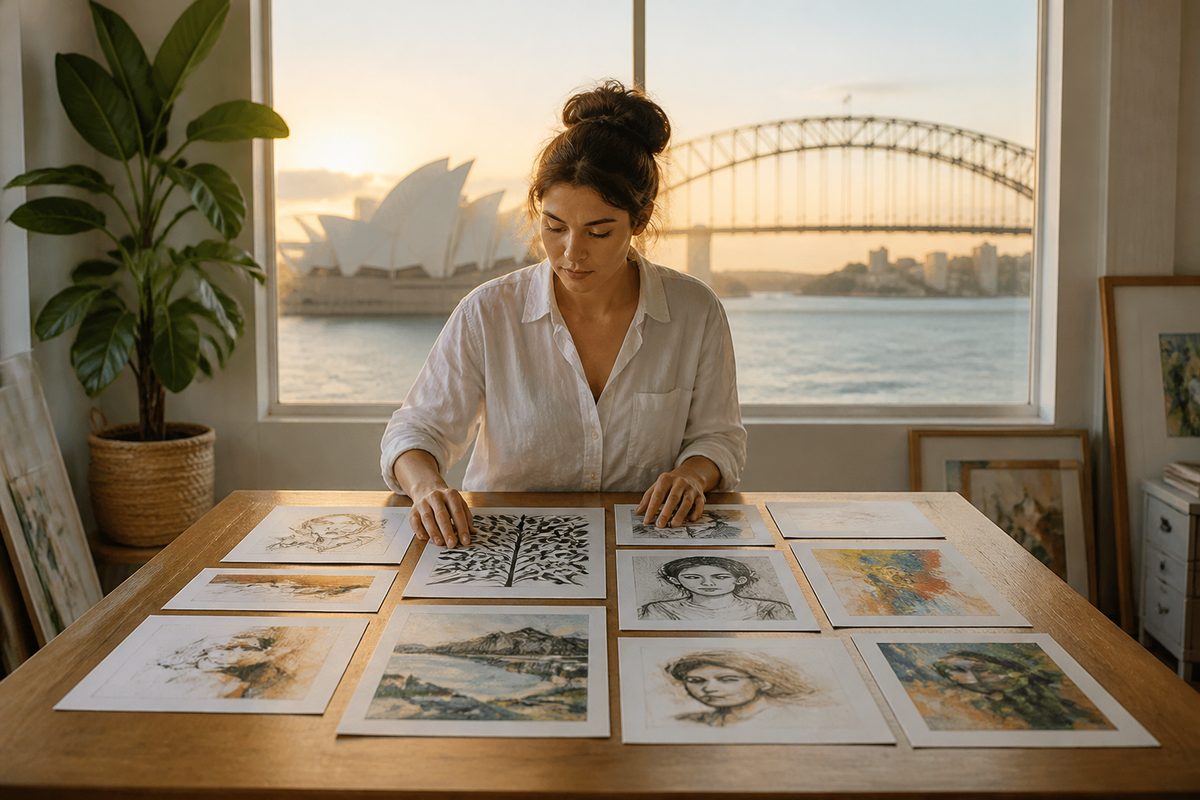
Most art portfolios work best with roughly 10 to 20 strong pieces, but the right number depends on who will review it and what they've asked for. A school program, a gallery application, a freelance client pitch and a personal website each have different limits. Ignore those limits and your portfolio is often judged harshly before anyone looks closely at the art.
This guide is about the decision itself. How do you work out your number? How do you cut down a larger body of work? And how do you present what's left? It's written for students, emerging artists and career changers who are staring at a studio full of work and wondering where to stop. For wider context on the regional art scene, see Sunraysia Arts Guide.
Why the Number Is Smaller Than You Think
Reviewers rarely see portfolios one at a time with unlimited attention. They work through a stack, often giving each a few minutes, and they form an impression early. So every weak piece waters down the strong ones.
A portfolio of twelve excellent works reads as confident. A portfolio of forty uneven works reads as someone who couldn't decide what mattered.
Quantity isn't proof of commitment. Reviewers look for judgement: can this person tell which of their own work succeeds? Editing is a skill in itself, and the number of pieces you include is the most visible sign of it.
Start With the Brief, Not the Studio
The most reliable way to find your number is to read the submission requirements and treat them as a hard ceiling. If the instructions say twelve images, send twelve. Sending fifteen tells them you didn't read the brief. That's the opposite of the impression you want.
When no number is given, use these working ranges as a starting point rather than a rule:
- Tertiary or art school applications: often somewhere between 10 and 20 works, but the school's own guidelines always override any general advice.
- Gallery or residency applications: commonly 8 to 15 images, usually tied to a coherent series.
- Freelance, commercial or illustration pitches: around 10 to 15 pieces, picked to match the type of client you're approaching.
- Personal website: a curated front page of roughly 12 to 20 works, with deeper archives behind it if you like.
- Casual conversation or studio visit: a handful of pieces, with more on hand if asked.
These ranges come from common practice, not a universal standard. Use them as a test for your plan.
Study Programs With Fixed Counts
Some programs set a precise structure. AP Art and Design, for example, asks students to submit work in sections. There's a smaller set of selected works, plus a larger sustained investigation that follows a line of inquiry over time. Requirements get revised now and then, so confirm the current numbers and rules with the official course materials before you plan anything.
The lesson applies even if you're not a student. A portfolio can hold two kinds of evidence: a few finished showpieces that prove technical quality, and a longer sequence that shows how you think. Many strong portfolios blend both. The sequence shows process, and the showpieces show mastery.
When applying to a College or university, also look for notes on whether sketchbook pages or process work count toward the total. Some programs welcome it. Others want only finished pieces. If the guidance is unclear, ask the admissions office rather than guessing.
Count Works, Not Files
One common source of confusion is what counts as a single piece. A triptych is one work made of three panels. A series of ten small studies may be one project. A detail shot of a larger canvas isn't a separate piece at all, even though it's a separate image.
Decide how you'll count before you start cutting. Here's a clear rule: if the pieces were made to be seen together, they're one work. If each could stand alone on a wall, each is its own piece.
Then check how the reviewer counts. Some forms ask for a number of images and others ask for a number of works, and that difference can change how many files you may upload.
If supporting detail shots are allowed, use them sparingly. One close-up that shows brushwork or surface texture can persuade. Five near-identical crops just repeat themselves.
Building the Shortlist
Begin by gathering everything you might include, without judging it yet. Then work through three passes.
- Remove the obvious misses. Anything unfinished, copied from a class exercise you didn't learn from, or below your current standard comes out first.
- Group by theme, medium or question. Clusters will emerge. A portfolio with three or four clear clusters is easier to follow than one with ten unrelated experiments.
- Choose the best in each group. Keep the strongest examples and cut the repeats, even if you're attached to them.
Stuck between two pieces? Keep the one that shows something the others don't. Variety within a clear direction beats two versions of the same success.
Balance Range and Focus
Every portfolio faces a tension. You want to show you can do many things, and you want to show you do one thing well. Where you land depends on the audience.
For an art school application, some range is often welcome. A mix of a Painting, a drawing, a print and maybe a sculptural piece shows you're open to learning. For a gallery or a commercial client, focus matters more.
They want to know what they'll get if they work with you. A consistent voice carries more weight than versatility.
Try this test. Lay all your chosen pieces on a table or screen and ask whether a stranger would guess they came from the same person. If not, and that's not your aim, you may have too many directions in one portfolio.
Show Evidence of Looking Closely
Reviewers notice whether you can see accurately. An Observational study, such as a drawing made straight from a still life, a figure or a landscape, shows this in a way imaginative work can't. Add one or two among your finished works. It reassures a reviewer that your more expressive pieces rest on solid skills.
Photography can play a similar role. If it's your main medium, it should lead the portfolio. If it's a supporting tool, say for gathering reference material, it may belong in your process notes instead. Be honest about which role it plays.
Process Work: How Much Is Enough
Process material should back up the finished work, not compete with it. Include process pages only where they explain something the final piece can't. One sketchbook spread showing how a composition grew is usually enough for a given work. Showing every stage of every piece makes the portfolio long without making it better.
Written Research can also help, especially for conceptual or contextual projects. A short paragraph on what you investigated, which artists or traditions shaped you, and what you changed along the way gives the reviewer a way into the work.
Keep it brief. Two or three sentences per project is typically enough. The art should still speak first.
Sequencing: Open Strong, Close Stronger
The order of pieces changes how the whole portfolio is read. Put a confident, representative piece first, because first impressions are hard to undo. Put another of your best works last, because the ending is what reviewers remember. Use the middle to build a rhythm, switching up scale, colour or subject so the viewer's attention doesn't go flat.
Avoid ordering by date unless the growth is the point. Chronological order often puts your oldest and weakest work at the start. That's the worst place for it.
Preparing Images That Do Justice to the Work
Even a perfect selection can be sunk by poor documentation. Each Digital image should be sharp, evenly lit and true to colour, with the work square to the camera and no distracting background. Photograph flat work in even daylight, or with two matching lights at angles to avoid glare. For three-dimensional work, show at least one view that explains scale and form.
Check the technical requirements before exporting. The preferred File format is usually stated in the instructions, most often JPEG or PDF, along with limits on size and file weight. If nothing is specified, a high quality JPEG at a moderate resolution is a safe default for online submissions. A PDF works well when you need to control page order and add captions.
Name files clearly, for example with your surname, a number and a short title, so they stay in order.
Label each image with the title, year, medium and dimensions. Consistent captions look professional and save the reviewer from guessing.
Digital Versus Physical Portfolios
Most submissions are now digital, which makes the count easy to enforce but also easy to bloat. A physical folio, asked for at an in-person interview, is a different task. You may have room for slightly more works, because you're there to guide the conversation. The principle is the same, though.
Bring the best selection, ordered with care, and be ready to explain your choices. Original pieces can be powerful in person, especially for texture and scale that a screen flattens. Just protect them in a clean, sturdy folder.
Adjusting Over Time
A portfolio isn't fixed. Treat it as a living document that you trim and refresh as your work develops. When you make something new that beats an older piece, swap the older one out rather than adding to the pile. The total stays steady while the quality rises.
It also helps to keep a master archive of everything you've made and a separate, tailored portfolio for each purpose. A version for a school application, another for a client pitch and a third for a gallery can draw from the same archive while differing in length and focus.
Common Mistakes to Avoid
- Padding to reach a round number. Ten excellent pieces beat fifteen with five fillers.
- Ignoring the stated limit. Going over is rarely rewarded.
- Showing near-duplicates. Repeated compositions suggest a narrow range or trouble editing.
- Poor photographs of good work. A weak image can make a strong piece look amateur.
- Leaving out context. Missing titles, dates and materials make the portfolio feel unfinished.
- Seeking approval for everything. Ask a trusted teacher or peer to review your shortlist, but make the final call yourself.
A Simple Way to Decide
Still unsure? Use this short routine. First, write down the audience and the stated limit. Second, pick the strongest piece you've ever made and make it your opener.
Third, choose pieces that support or contrast with it until you reach the lower end of the permitted range. Fourth, ask whether any remaining piece adds something new. If it does, include it. If not, leave it out.
Stopping a little short of the maximum is often wiser than filling every slot. A reviewer who finishes your portfolio wanting more is in a far better mood than one who's tired by the end.
Bottom Line
For most purposes, aim for about 10 to 20 carefully chosen pieces, and always defer to any number the reviewer gives you. Count works consistently, balance range with a clear direction, document each piece well, and keep the sequence deliberate. A smaller portfolio that's sharply edited and well presented will almost always beat a larger one that tries to show everything.
When planning how many pieces for an art portfolio, quality matters more than quantity, and most applications are best served by a focused selection of roughly 10 to 20 pieces. Each work of art you include should earn its place by showing your skill, your range, and a consistent point of view, so cut anything that feels weaker or repetitive. Always check the specific requirements of the school or program, since they may set a minimum or maximum number of pieces.